

The spectral DR non-contrast system uses a high-density detector with a pixel pitch of 0.8 mm, and each pixel can be subdivided into 128 energy channels, which can simultaneously collect transmission images and corresponding absorption spectral data. In the demonstration, the system completed the non-scan detection of 5 types of flammable and explosive substances, automatically obtained their transmission images in the whole process, and superimposed spectral line information to achieve rapid differentiation of different substance types. The high sensitivity and spatial resolution of the laser line array detector ensure clear spectral features can be extracted even in dense or overlapping samples.
With the high-precision recognition of absorption edge transitions and multi-channel data fusion algorithms, the system has shown broad application prospects in explosion-proof security inspection, criminal investigation and forensics, mineral resources exploration and other fields. The laboratory is promoting the engineering and on-site adaptation of this technology, with the goal of realizing online monitoring and real-time early warning, and providing one-stop, non-destructive, quantitative intelligent detection solutions for public safety and industrial monitoring.


We developed a portable broadband lightsource X-ray absorption spectroscopy (BL-XAS) system integrated with a novel deep-learning classifier. The hardware combines a 128-channel CdTe photon-counting detector with a tungsten-target X-ray source. We propose the Parallelized Retention Encoder PR-Encoder that places gated multi-scale retention and multi-layer perceptron modules on parallel computation paths to reduce per-layer latency and accelerate inference. Trained on 2000 spectra from 10 explosive materials, the PR-Encoder was evaluated against two baseline models. Transformer baselines achieved 88.5% classification accuracy with a per-spectrum inference latency of 13.1 ms, while Retention encoders reached 90.1% accuracy with 12.5 ms latency. In contrast, the PR-Encoder attained the highest performance — 93.4% accuracy under ten-fold cross-validation, with an average inference latency of approximately 10.1 ms per spectrum, demonstrating superior accuracy and computational efficiency. Integrating portable BL-XAS instrumentation with retention-based deep learning provides a real-time and non-destructive solution for explosive security screening.
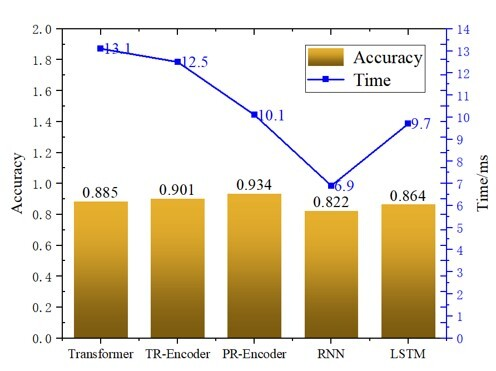
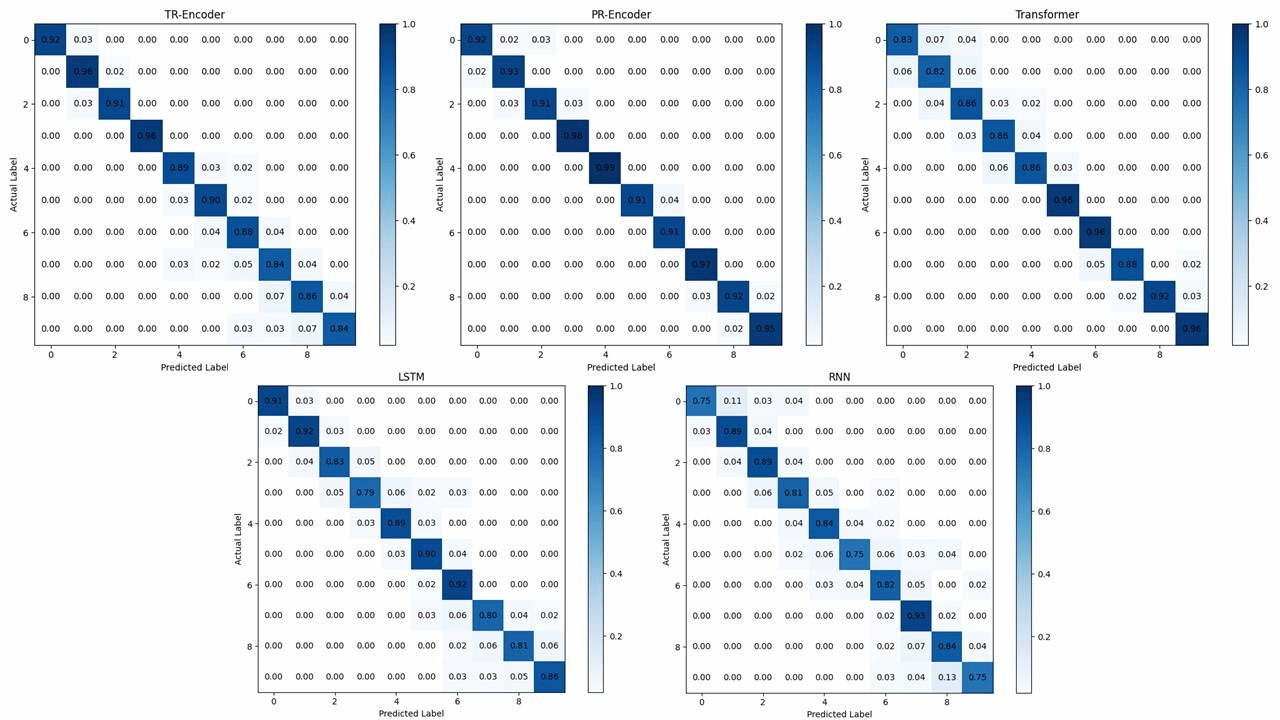
From an engineering perspective, the advantages of the proposed approachare threefold: (i) rapid spectral acquisition enabled by a custom-built photon-counting CdTe detector and pulsed source, (ii) highly efficient featureextraction and classification achieved through the novel PR-Encoder architecture,and (iii) exceptional adaptability to concealed or densely packedsamples. Collectively, these contributions establish a clear route toward thepractical deployment of portable XAS systems in applications such as airportsecurity, customs inspection, and public safety monitoring. Future work willfocus on improving the system’s energy resolution and expanding the spectraldatabase to enhance classification robustness in complex real-world scenarios.